Wednesday, April 28, 2010

The Handmaid's Tale (novel)


The Handmaid's Tale by Margaret Atwood

Offred is a Handmaid living in Gilead, a fictional futuristic city. The President of the US, as well as the rest of the government, has been assassinated, and the US has been taken over by a religious regime under which women are forbidden to read or learn and are valued only for their capacity for reproduction. Offred, like every other woman of childbearing age and ability, has been torn from her family, her husband likely killed, her daughter stolen and given to a new family, and placed at her "post" where she is expected to produce offspring for her Commander. The Handmaids are, in fact, forced into surrogacy, becoming pregnant with their Commanders' babies and then forced to give their babies over to their Commander and his wife. This is a time of public executions and extreme oppression; a time in which women are not allowed to read, are forced to cover themselves from head to toe, are forbidden from making friends or forging any attachments at all. In the end. the reader is given the opportunity to at least wonder if Offred succeeded in escaping this hell and starting a new life elsewhere; the question is never answered definitively.

I didn't really enjoy the story. It was well-written to be sure, but I found it strange, dark, and depressing. I think it's categorized as a must-read, though, so if anyone wants my copy, say the word.

Monday, April 12, 2010

The New Atheism (non-fiction)


The New Atheism by Victor J. Stenger

It's official: there is no God, something I've known for a long time. Okay, that's a little tongue-in-cheek, but in all seriousness, in this book, Dr. Stenger makes the case that any belief in supernatural is irrational, that everything we know, from the farthest galaxies to the inner workings of our brains - including our thoughts, emotions and personalities - can be reduced to matter and physiological mechanisms, and nothing more, and that not a shred of proof of the existence of God has ever been brought to light. Believers argue that the existence of God is beyond the reaches of science, but that in itself seems irrational (and convenient). After all, if God plays such an important role in the world and in people's individual lives, if people have a "personal and intimate relationship with God," as I've heard people claim, then there should be some evidence of "his" existence. And there's just not, folks - never has been. The bible is not historical fact - it's a collection of stories written by a group of men long, long after Jesus Christ supposedly died (the truth is, there's not even any historical proof that Jesus Christ actually existed; he very well may be a mythical figure). At best the stories are fables and parables; at worst they are tools used to brainwash.

There is no accounting for all the evil and suffering in the world, either. Man's free will, supposedly granted by God, doesn't cut it. How does that explain natural disasters like the earthquake in Haiti that recently killed hundreds of thousands of people? But the best believers seem to be able to come up with is "God works in mysterious ways . . . it's not for us to understand." Well, I'm calling bullshit, and so are a lot of other people, fortunately, including Dr. Stenger.

The book also talks about how religion and belief in the supernatural is actually dangerous; how making decisions based on irrational, baseless faith and superstition rather than on reason and logic can result in terrible consequences, and how so many of man's evil deeds are committed in the name of God. Religion encourages racism and oppression and violence and intolerance, and at the extreme, even killing. Non-believers don't exclude or kill in the name of Atheism. Non-believers value the world and life because we know it's all we've got.

It's interesting to me that so many people who consider themselves true believers were either born into it (i.e., had it spoon-fed to them from infancy), or they "found God" after hitting some sort of rock bottom in their lives. "I was a broken person, but God made me whole." I've heard it over and over. But just like The Cowardly Lion, The Tin Man, and The Scarecrow, the courage, the heart, and the brains they eventually got, they actually had all along - none of it came from The Wizard, who, as we all know, turned out to not be real.

Okay, enough of my personal rantings. Back to the book. The author, a scientist, tends to throw sarcastic barbs in from time to time, which I think the book could have done without. He also goes into some pretty mind-numbing, coma-inducing stuff about things like physics and quantum mechanics. Overall, though, he does a superb job of explaining the position that there is no God and that the world would be a much better place without religion.

I would challenge ye of religious faith to read this book. What do you have to lose? For the record, I've read at least some of the bible and have attended many a church service and listened to many a sermon in my day.

Told ya my next book was going to be controversial.

Thursday, April 8, 2010

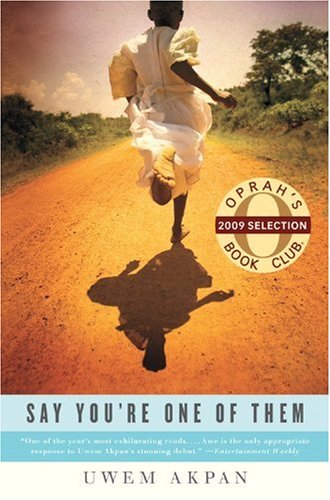
Say You're One Of Them

Say You're One Of Them by Uwem Akpan is a book of 3 long short stories and 2 shorter stories about different countries in Africa, with children or young adults as the central characters.

Using young people as the main characters seemed to really make the stories more touching, especially given the conflicts portrayed in the book. Religious and tribal conflicts and sheer poverty are the main themes.

Although I had glancing knowledge about Africa and its troubles, these stories really gave a new dimension to my understanding. The stories are very engrossing and easy to read, with the possible exception of one which uses a lot of African dialect. The story set in Rwanda struck me as the most moving and harrowing.

They are sad stories, though, but given the state of Africa, that's not surprising. It is a good read and I recommend it. (This one is on my Kindle)

Wednesday, April 7, 2010

The Little Giant of Aberdeen County (novel)


Hmmm. The cover touts this as "THE NATIONALLY ACCLAIMED BESTSELLER." I don't get it.

It tells the story of Truly, a giant (literally; she is born with the condition acromegaly) living in a small town. Being a person with a condition that makes her vastly different from the people around her subjects her to the predictable taunts and rejection, made all the more extreme since she grows up in the shadow of her beautiful, petite, seemingly perfect sister. Eventually Truly's perfect sister leaves town, and in the aftermath of her disappearance, Truly is left to hold together the small, dysfunctional family her sister leaves behind. Truly discovers the secrets stitched together in an old quilt made by a long-dead descendant of her brother-in-law, and suddenly finds herself holding the power to heal and to harm in the palm of her hand.

I suppose this story is about how love can transcend everything. The author has a knack for writing with a very colorful hand and creating larger-than-life characters. I liked her storytelling style, but not so much the actual story. I stuck with it to the end, but found that I never grew attached to any of the characters and was glad when I finally turned the last page.

That said, this book has gotten some really good reviews on Barnes & Noble and Amazon, so maybe it's just me. Anyone want my copy? It's up for grabs.

The book I'm working my way through now oughta make for some interesting discussion.

Saturday, March 27, 2010

The Immortal Life of Henrietta Lacks (non-fiction)


In 1951 a young black woman by the name of Henrietta Lacks was diagnosed with what turned out to be an extremely aggressive form of cervical cancer. During her treatment, tissue was removed from her body and placed in a petrie dish where her malignant cells continued to divide and multiply, resulting in the first ever immortal cell line. Ms. Lacks died within months of first being diagnosed with cancer, leaving behind a husband and five children.

This book tells the little-known story of Henrietta Lacks's short life, the development of her immortal cell line, and how her family has been impacted by both her death and finding out 20 years after her death that her cells were still very much alive and spread all over the globe in laboratories, hospitals, and tissue banks.

Henrietta's cells are still alive today, and it is safe to say that every person alive today who has benefited in any way from medical science has benefited from her cell line. They have been used (and continue to be used) to study gene mapping, develop vaccines, medications, and even in vitro fertilization, research cancer and cancer treatments, study the effects of chemicals, cosmetics, drugs, environmental pollutants, and a variety of other things on living cells. What is ironic is that the descendants of Henrietta Lacks live in poverty and many of them cannot even afford health care.

What is equally appalling is that Ms. Lacks's cells were taken from her body and used for research without her knowledge or consent. And while this may be shocking, what a lot of people don't realize (I didn't!) is that people only have rights over the tissues and bodily fluids that are attached to their bodies - once something is removed from your body, it's no longer yours. That was true in 1951, and it's still true today. This certainly raises some interesting ethical and moral questions.

It took the author about ten years to research and write the book, and I was completely engrossed from the first page. The author captures the very colorful and human side of the story, going into great depth about Henrietta and her family, as well as managing to convey all the technical science-y stuff in very readable layman's terms.

I'm hanging onto this one, hoping I can get my husband to read it, but I highly recommend it.

Tuesday, March 23, 2010

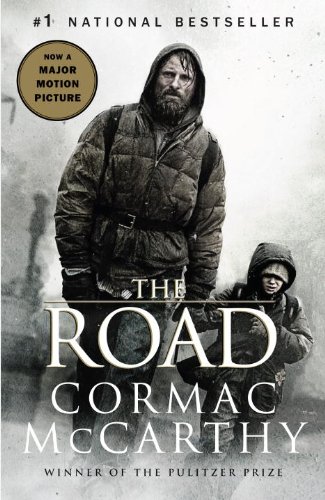
The Road

I thought it would be fun to read all the Pulitzer Prize winners from the past decade or so this year. Of course, The Road by Cormac McCarthy is anything but fun.

It's a bleak portray of survival during some undefined post-apocalyptic time. A study in "what it means to be human". A father and his son trying to make it day by day when all around them are murdering gangs and cannibalism. A Mad Max movie without a heroic Mel Gibson character.

Survival and humanity in and of itself is heroic, I suppose. Giving to others even when you have nothing.

Definitely thought-provoking and moving. Some find the triumph of humanity against all odds uplifting, but honestly I though the book was depressing. I just don't think humans will survive when everything is dead in the world. Still, I recommend it, just keep in mind the story's bleakness.

This one's on my Kindle, so just offering up a review!

Saturday, March 20, 2010

Hotel on the Corner of Bitter and Sweet (novel)


This is my book club's current selection. I am not a fan of romance novels on principle; I'm too much of a cynic. Not that this is a trashy romance novel, but it is a love story, and one that found me with a lump in my throat and tears in my eyes more than a few times, despite myself. It tells the story of two young teens, a Chinese boy and a Japanese girl, both American by birth and living on the Pacific coast during WWII, who fall in love but are thwarted by both the boy's father who sees anyone Japanese as the enemy, and the war itself which results in all persons of Japanese ancestry being evacuated to "relocation camps" for the duration of the war.

It gives an interesting look at the internment of Japanese-American citizens during WWII. I've heard vague allusions to concentrations camps right here on American soil during the war, but never really knew much about them until now. The novel inspired me to do a little online research of my own into this shameful slice of American history. The concentration camps here were very different from the Nazi concentration camps everyone has become familiar with; the prisoners were generally treated well and were only held until the war was over and then released. However, these were American citizens who were suddenly stripped of their rights and forced to pack whatever could fit into a suitcase, leaving the rest of their belongings behind, in most cases never to be retrieved, and to move hundreds of miles away to live in substandard housing in desolate areas.

The main character, Henry, a Chinese-American boy, makes many valiant attempts to hold onto his Japanese sweetheart, but of course they are eventually separated and go on to lead very separate lives, with only distant memories and tender heartache for the absence of the other. I won't give away the ending; read it for yourself. Mine's up for grabs.