Saturday, March 20, 2010

Hotel on the Corner of Bitter and Sweet (novel)


This is my book club's current selection. I am not a fan of romance novels on principle; I'm too much of a cynic. Not that this is a trashy romance novel, but it is a love story, and one that found me with a lump in my throat and tears in my eyes more than a few times, despite myself. It tells the story of two young teens, a Chinese boy and a Japanese girl, both American by birth and living on the Pacific coast during WWII, who fall in love but are thwarted by both the boy's father who sees anyone Japanese as the enemy, and the war itself which results in all persons of Japanese ancestry being evacuated to "relocation camps" for the duration of the war.

It gives an interesting look at the internment of Japanese-American citizens during WWII. I've heard vague allusions to concentrations camps right here on American soil during the war, but never really knew much about them until now. The novel inspired me to do a little online research of my own into this shameful slice of American history. The concentration camps here were very different from the Nazi concentration camps everyone has become familiar with; the prisoners were generally treated well and were only held until the war was over and then released. However, these were American citizens who were suddenly stripped of their rights and forced to pack whatever could fit into a suitcase, leaving the rest of their belongings behind, in most cases never to be retrieved, and to move hundreds of miles away to live in substandard housing in desolate areas.

The main character, Henry, a Chinese-American boy, makes many valiant attempts to hold onto his Japanese sweetheart, but of course they are eventually separated and go on to lead very separate lives, with only distant memories and tender heartache for the absence of the other. I won't give away the ending; read it for yourself. Mine's up for grabs.

Tuesday, March 16, 2010

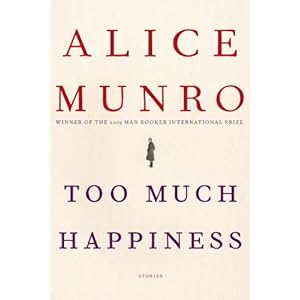
Too Much Happiness

I find it really odd that Alice Munro's latest collection of short stories (and 2009 Booker Prize winner), Too Much Happiness is pretty darn depressing.

Some of the 10 stories are unbelievably tragic. But two in particular moved me.

"Face" is told as a man recounting his childhood--the man was born with a port wine birthmark. His father is horrified and wants his wife to put the baby in an institution, as they probably did when the story takes place. But the mom doesn't and the son turns out to have a successful life, even though the father would not even look at him. In one scene, the boy is playing with a childhood friend, when his friend paints half of her face purple. Not being mean, but because she wanted to be like him. But the boy's mom completely freaked out. However, at that point she realized that she could no longer shelter him from the world and enrolled him in boarding school.

Another story "Child's Play" is also told as a character (Marlene) recounting her childhood. The story centers around a secret she's carried all her life about a time in camp with her best friend Charlene. And the family who shared their duplex and the girl Verna who lived there. And Verna is a "Special."

This part of the story takes place right after the Depression, right before WWII. But I wonder if the sentiments that are relayed here are still true among kids today. "From the very beginning I had an aversion to her unlike anything I had felt up to that time for any other person. I said that I hated her, and my mother said, How can you, what has she ever done to you?" "Children of course are monstrously conventional, repelled at once by whatever is off-center, out of whack, unmangeable."

Verna shows up at summer camp (along with other "Specials", I was actually sort of impressed that they were trying to include them with the other kids back in the 1930s) and what happens between Verna and Marlene & Charlene ends up being tragic.

But it is something that haunts them until adulthood. Marlene even writes a book that explores "the attitude towards people who are mentally or physically unique."

And the story haunted me also. A child's view of the intellectually disabled. I couldn't read anything else for weeks and I still cry when I think about it.

This hardcover book is up for grabs. I'm wondering if anyone else feels the same way about that story (the other eight stories are also very good and insightful, although a couple of them had me scratching my head).

Tuesday, March 9, 2010

Little Bee (novel)

Little Bee by Chris Cleave

The back of this book reads:

We don't want to tell you WHAT HAPPENS in this book.

It is a truly SPECIAL STORY and we don't want to spoil it.

NEVERTHELESS, you need to know enough to buy it, so we will just say this:

This is the story of two women. Their lives collide one fateful day, and one of them has to make a terrible choice, the kind of choice we hope you never have to face. Two years later, they meet again - the story starts there . . .

Once you have read it, you'll want to tell your friends about it. When you do, please don't tell them what happens. The magic is in how the story unfolds.

Huh. Can't beat that for marketing, eh?

Without giving away what happens in the story, I'll just say that it centers around a young Nigerian refugee girl and an upper-middle class English wife and mother. What the story is about is making choices between saving fellow human beings and saving ourselves, and how it is possible to harm even while saving, and to save even while harming. It's a story about dilemmas and following our own moral compasses.

I liked this story, but I was not blown away by it as the front cover claimed I would be. It's a good book, but I don't think it lives up to the hype on the back cover. But maybe I'm just missing something . . . ?

Judge for yourself; it's up for grabs.

Monday, March 1, 2010

Lark and Termite (novel)

Lark and Termite by Jayne Anne Phillips

In this book, the author weaves together the stories of a young soldier shot down in the Korean War, and the reverberations of that event nine years later for a small, unconventional family in West Virginia. The two title characters are Lark, a seventeen-year-old girl, and the first-born daughter of the young soldier's wife from a previous relationship, and "Termite," the girl's younger half-brother and son of the fallen soldier. Lark and Termite are being raised by their aunt, although it is mostly Lark who raises and cares for Termite, who was born with spina bifida and hydrocephaly. The relationship between the siblings is one of great love and tenderness.

I'm still trying to decide how much I liked this book. I wanted to love it, to come away thinking "this is one of the best books I've ever read," in part because of the National Book Award Finalist sticker on the cover, and in part because the story involves a little boy with disabilities, for which I have a tender spot. But in truth, I had some trouble with this book because it took a great deal of concentration to decipher the prose, which is told in a sort of an eerie, dream-like narrative.

It's a good story . . . maybe not exactly my cup of tea, but it's gotten wonderful reviews. Anyone who wants my copy, let me know.

Sunday, February 21, 2010

Between Me and the River (memoir)

Between Me and the River: Living Beyond Cancer, a memoir by Carrie Host

At the age of 40, when her youngest child was only ten months old, Carrie Host was diagnosed with carcinoid tumor, a rare and incurable form of cancer - one that responds to neither chemo nor radiation. Surgery is the only available treatment, but the tumors always comes back, it's the nature of this form of cancer. In a split second, her life is shattered, and the lives of her family and loved ones are thrown into despair and upheaval. After surviving a horrific surgery to remove "98 to 99 percent" of the tumors that filled her abdominal cavity and covered most of her major organs, she then almost dies from a resulting staph infection. Ms. Host tells the first part of her story in slow, agonizing detail; the second half of the book moves along in time at a much quicker pace. She describes not only the physical horrors of her disease and the surgeries she must undergo, but the terrible emotional toll it takes on her and her family.

I was drawn to this book for obvious reasons, having only recently traveled down a similar path with my husband (although his cancer was of a different variety). Although I wasn't the one who had the cancer, I can say that when someone has cancer, it's like the entire nuclear family has cancer. I identified with a lot of what the author wrote about in her book - the fear and uncertainty, feeling a separation from the people around you when you go through something like this, and the feeling of "What now?" when you realize that there is still the rest of your life to be lived, regardless of how long or short that might be.

She ends many of her chapters with little nuggets of wisdom, which, truthfully, irritated me after a while. Also, her reference to "angels" and her constant comparison of her diagnosis of cancer to a river or other raging body of water became tiring. However, I generally liked it and would recommend it to anyone who has been touched by cancer.

Mine's up for grabs; let me know if you want it.

Sunday, February 14, 2010

Push (novel)


Push by Sapphire

Most everyone has heard of this book now that the movie, Precious, based on this novel is getting Oscar buzz.

Rather than try to describe the story in my own words, I'll quote from the back cover:

Precious Jones, an illiterate sixteen-year-old, has up until now been invisible: invisible to the father who rapes her and the mother who batters her and to the authorities who dismiss her as just one more of Harlem's casualties. But when Precious, pregnant with a second child by her father, meets a determined and highly radical teacher, we follow her on a journey of education and enlightenment as Precious learns not only how to write about her life, but how to make it her own for the first time.

This was a hard read. Not in plot complexity, but just emotionally wrenching. Some of the most horrific things you can imagine happening to a child happen in this story. I was hesitant to read it, and I'm still not sure what prompted me to take the leap, as it's not for the faint of heart, and I am of the faint of heart when it comes to the horrors that take place in this book. I'm not giving it a bad review, however; I don't mean to convey that it's not a good book. It's poetic and very well-written and evokes an emotional - and even physical - response. It's just hard.

Judge for yourself. If you want my copy, let me know.

I need something light and happy to read now!

Saturday, February 13, 2010

Little Heathens (memoir)

Little Heathens by Mildred Armstrong Kalish

I don't think I've ever actually used the word "delightful" to describe anything, but that's the word I would use to describe this book. Just as its subtitle states, this is the story of "Hard Times and High Spirits on an Iowa Farm during the Great Depression." In it, the author tells of growing up with her siblings, cousins, aunts, uncles and grandparents on an Iowa farm during the 1930s. Reading the book feels like a balm; like having a sweet old grandmother tell you stories from her youth, from a time and lifestyle long gone. She tells the story as if speaking directly to you, the reader, which I found charming.

Not only does Ms. Kalish tell of events, but she throws in plenty of homespun recipes that she grew up with (for such things as homemade marshmallows, succotash, authentic shortcake, and even soap) as well as describing such things as how to catch and skin a rabbit and how to behead a goose to be eaten for Thanksgiving dinner. There are also lots of old photos from the author's youth sprinkled throughout the book.

Reading this took me to a time and place I can hardly imagine - a time and place where people were at one with the land they lived on, who didn't eat a single thing that wasn't cultivated and raised with their own hands, where nothing was ever wasted or taken for granted, and everything was recycled until it dwindled down to nothing, and where ingenuity was relied on for work and for play. It made me feel guilty and ashamed of all the waste and excess we indulge in today. It also made me wonder what - if any - work ethic our kids are being instilled with. On that farm way back when, by the time children were preschool age (not that they had preschool), they were expected to help - it was just a way of life. Everyone's survival depended on everyone cooperating and contributing.

In the end, the author admits that distance from events tends, for some people, to make the heart grow fonder of them. Apparently, her sister did not retain such fond memories of their youth on the farm. Still, the author seems like such an amazing and down-to-earth person (and she's still living, well into her 80s, the sole survivor of her immediate family), and tells her stories with such enthusiasm and charm. I really loved this book and would recommend it.

Mine's up for grabs if anyone wants it!